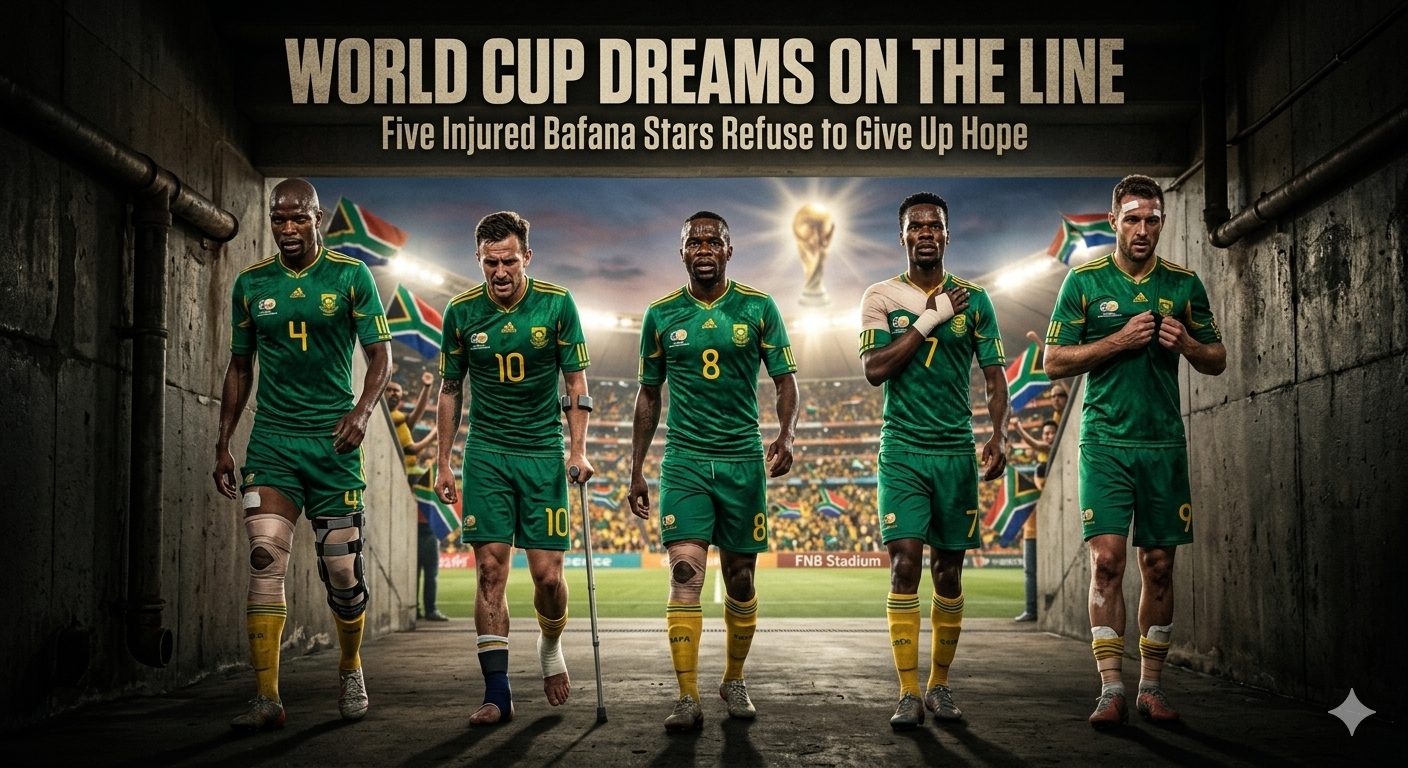
The path to the FIFA World Cup is rarely a straight line. For any professional footballer, it is a journey defined by sweat, tactical discipline, and the sheer will to overcome continental giants. But for five pivotal members of the Bafana Bafana squad, the road to 2026 has hit a devastating detour: the treatment room. As South Africa gathers momentum under the steady hand of Hugo Broos, a shadow has been cast by a series of high-profile injuries that threaten to derail individual dreams while testing the depth of the national project.
In the high-stakes environment of international football, an injury is more than just a physical setback; it is a psychological battle against time. For these five stars, the diagnosis was a heartbreak, but their collective response has been one of defiant optimism. This is a story of resilience, the cutting edge of sports science, and the unyielding hope of representing the Rainbow Nation on the world’s grandest stage.
The Anatomy of a Crisis: Why Depth Matters Now More Than Ever
Before diving into the individual stories of these athletes, it is crucial to understand the context of the current Bafana Bafana cycle. South Africa is currently enjoying its most stable period in over a decade. The bronze medal at the last AFCON proved that the tactical foundation is solid. However, that stability is built on specific “irreplaceable” profiles—players whose tactical intelligence and physical attributes define the way Hugo Broos wants to play.
When five of these profiles are sidelined simultaneously, it creates a “stress test” for the national team’s structures. It forces the technical team to look at the domestic league for immediate replacements, but more importantly, it puts the spotlight on the medical rehabilitation protocols that determine how quickly—and how safely—these stars can return to the pitch.
1. The Defensive Anchor: A Race Against the Clock
The first of our five stars represents the literal backbone of the team. A modern center-back in Broos’ system isn’t just a stopper; they are the first point of attack, responsible for breaking the initial line of the opposition’s press. A severe ligament tear suffered during a high-intensity club fixture has left this star in a race against the calendar.
Rehabilitating a knee injury for a professional footballer is a grueling 24/7 job. It starts with the “quiet phase”—weeks of controlled inflammation and basic mobility work that tests the player’s mental fortitude. For this defender, the dream of the World Cup is what fuels the 6:00 AM physiotherapy sessions. He refuses to accept a “spectator” role. His recovery isn’t just about his own career; it’s about ensuring that Bafana Bafana doesn’t lose the leadership and organizational vocal cords that he provides from the back.
2. The Creative Engine: Managing the Psychological Load
Midfielders are the marathon runners of the team, covering upwards of 12 kilometers per match. When a recurring muscular injury sidelined Bafana’s primary playmaker, the concern wasn’t just physical, but systemic. Without his vision, the transition from defense to attack loses its fluidity.
For this player, the “refusal to give up hope” takes a different form. It is about the discipline of not rushing back too soon. The “hope” here is managed by sports psychologists who work to ensure that the fear of re-injury doesn’t diminish his flair once he returns. He has been vocal in camp, even while on crutches, acting as a mentor to the younger players stepping into his boots. His journey back is a lesson in patience—a strategic retreat to ensure a more powerful return for the final round of qualifiers.
3. The Speed Merchant: When the Body’s Best Asset Fails
In modern football, pace is a premium. One of Bafana’s most dangerous wingers, known for his ability to turn a defensive clearance into a counter-attacking goal in under ten seconds, saw his progress halted by a high-grade hamstring tear. For a player whose game is built on explosive acceleration, this injury is particularly terrifying.
The rehabilitation for “explosive” players requires a delicate balance of strength training and plyometrics. He is currently working with specialized sprinters’ coaches to rebuild his running mechanics from the ground up. His refusal to give up hope is visible in his social media updates—not of goals, but of him pushing sleds and doing resistance band work. He knows that a Bafana Bafana side with his pace is a different beast entirely, and he is determined to provide Hugo Broos with that “X-factor” when the flight to the World Cup is finally booked.
4. The Rising Star: The Resilience of Youth
Perhaps the most tragic of the five is the young prodigy who had just broken into the starting XI before a fractured metatarsal sidelined him. For a young player, an injury during a breakout season can feel like the end of the world. There is the persistent fear that “the train will leave without them.”
However, this young star has displayed a maturity beyond his years. Instead of retreating into isolation, he has used the time to study the game. He spends his recovery hours analyzing film of European leagues, improving his tactical understanding while his bone heals. His hope is anchored in the belief that he isn’t just returning to the team; he is returning as a smarter, more complete player. His story serves as an inspiration to the U-23 squads, proving that setbacks are merely setups for a stronger comeback.
5. The Veteran Leader: The Final Hurdle
The fifth player is the veteran—the man for whom the 2026 World Cup represents the “Last Dance.” A chronic Achilles issue has plagued his recent months, leading many pundits to suggest he should retire and move into coaching. He has ignored the noise.
For the veteran, the refusal to give up hope is a battle against biology. He is utilizing advanced recovery methods, including cryotherapy and hyperbaric oxygen chambers, to extend his career by just those few crucial months. He isn’t seeking a starting role; he is seeking to be the “calm in the storm” for the squad. His presence in the locker room, even in a non-playing capacity during his rehab, is vital for the team’s “Respect the Journey” ethos. He knows what it means to represent South Africa, and he refuses to let his final chapter be written by an injury.
The Role of Sports Science: The Invisible Team
While the players provide the hope, a team of dedicated professionals provides the means. The South African national team’s medical department has evolved significantly. The use of GPS tracking data, sweat analysis, and personalized nutrition plans has turned “hope” into a scientific certainty.
The integration between club medical teams and the national team setup has reached an all-time high. This synergy ensures that when a player like Mokoena or any other Bafana star is injured, there is a seamless transition of data. We are no longer in the era of “wait and see”; we are in the era of “predict and perform.” This technological backing is a huge reason why these five players remain so confident. They aren’t just wishing for a recovery—they are following a data-driven roadmap to health.
The Tactical Impact: How Hugo Broos Adapts
A coach’s nightmare is a long injury list, but Hugo Broos has used this crisis to further strengthen the squad’s “Next Man Up” philosophy. By being forced to play without these five stars during certain windows, Broos has uncovered new talents and tested alternative tactical shapes.
This period of adversity has actually deepened the talent pool. When these five stars eventually return, they will find a squad that is more resilient and competitive than the one they left. This internal competition is the hallmark of a world-class national team. Broos has maintained a “no excuses” environment, ensuring that the dream of the World Cup remains a collective goal, regardless of who is currently in the physio’s room.
The Fans’ Role: The 12th Man in Rehabilitation
One cannot overlook the impact of the South African public. In the age of digital connectivity, injured players are constantly reminded of their value through messages of support. This “social fuel” is a vital component of the recovery process. When a player feels the weight of a nation’s hope, the pain of a rehab session becomes more bearable.
The “Respect the Journey” campaign isn’t just for the coach; it’s for these players. The fans have learned to appreciate the grind of the comeback. This cultural shift—from criticizing an injured player to supporting their return—has created a much healthier environment for the national team to thrive in.
The Road to 2026: A Unified Dream
As the qualifiers approach their crescendo, the status of these five players remains the most discussed topic in South African sports. Will they be ready? Will they be the same players they were before?
The answer lies in their collective refusal to yield. The journey to the World Cup is a marathon, not a sprint. It is a path paved with obstacles, both on the field and in the clinic. These five stars represent the spirit of Bafana Bafana—a team that has been through the wilderness and is now clawing its way back to the top.
Their recovery is a microcosm of the national team’s own “rebuild.” Just as Hugo Broos had to fix the structural issues of the squad over five years, these players are fixing their physical structures. The “World Cup Dream” is the North Star that keeps them moving.
Final Thoughts
The story of the “Injured Five” is a testament to the fact that football is as much about the mind as it is about the feet. As they transition from the gym back to the grass, they carry with them the lessons of adversity. They remind us that “hope” is not a passive emotion; it is an active, daily choice to do the work required to succeed.
For Bafana Bafana, the 2026 World Cup isn’t just a tournament; it’s a destination that requires every ounce of the nation’s talent. Whether through the brilliance of those on the pitch or the resilience of those fighting to get back on it, South Africa is moving forward. The stars may be injured, but the dream has never been healthier.
Deixe um comentário