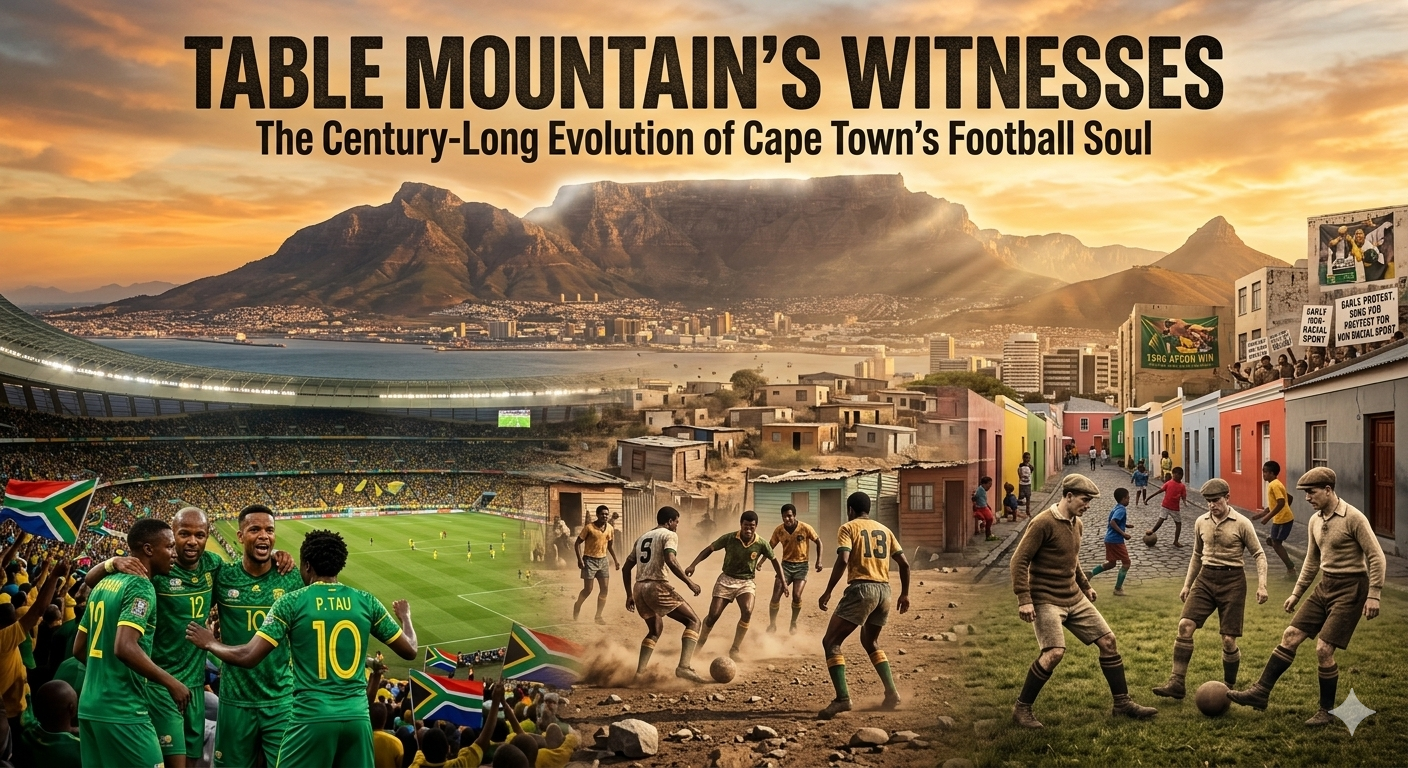
The silhouette of Table Mountain is more than a geographical landmark; it is a silent observer of a century of transformation. For the people of Cape Town, the “Mother City,” this ancient rock has looked down upon a footballing evolution that mirrors the very soul of South Africa. From the dusty, segregated pitches of the early 20th century to the architectural marvel of the Cape Town Stadium, the journey of football in this region is a tapestry of turmoil, defiance, and eventual triumph. To understand the legacy of Bafana Bafana in the Cape, one must first understand the ground upon which that legacy was built.
The Genesis: Football as a Breath of Freedom
In the early 1900s, football in Cape Town was not merely a game; it was a communal heartbeat. While the colonial influence brought the sport to the shores of Table Bay, the local communities—particularly in areas like District Six and the Cape Flats—reclaimed it as their own. In these formative years, the “football soul” of the city was forged in the heat of amateur leagues that defied the growing shadows of institutionalized segregation.
Clubs like those in the Western Province Football Board became sanctuaries. For the disenfranchised, the football pitch was one of the few places where dignity could be maintained and where the talent of the “Cape-born” players could shine. The style of play developed here was distinct: a rhythmic, short-passing game influenced by the tight spaces of urban life, a precursor to the flair that would later define South African football on the global stage.
The Darkest Hour: Apartheid and the Scarred Landscape
As the mid-century approached, the rise of Apartheid introduced a period of profound turmoil. The Group Areas Act did not just move people; it attempted to kill the city’s footballing soul. The destruction of District Six meant the loss of historic playing fields and the forced relocation of clubs to the peripheral, often neglected, Cape Flats.
Despite this, the flame of the game refused to flicker out. The “Double Pro” era—where players would play for both their community teams and professional setups—became a symbol of resistance. Cape Town became a hotbed for the South African Council on Sport (SACOS), which operated under the mantra “No normal sport in an abnormal society.” This period was characterized by a painful paradox: the city possessed some of the most gifted players in Africa, yet they were invisible to the world, locked behind the bars of international boycotts and domestic oppression.
The 1990s: A New Dawn and the Birth of Bafana Bafana
The release of Nelson Mandela and the subsequent unbanning of political organizations in 1990 paved the way for the unification of South African football. For Cape Town, this was the moment of “The Great Rejoining.” When Bafana Bafana was officially born in 1992, the city’s football fans—who had spent decades supporting international teams in the absence of their own—finally had a national identity to embrace.
The early Bafana Bafana era in Cape Town was electric. The city’s diverse population saw the national team as a vehicle for reconciliation. Players from the Cape, such as Shaun Bartlett, Benni McCarthy, and Quinton Fortune, became the faces of this new era. These individuals didn’t just play for South Africa; they carried the specific “Cape flavor” of football—a blend of technical precision and immense mental strength—into the heart of the national squad.
The Benni McCarthy Phenomenon: A Son of the Flats
No discussion of Cape Town’s football soul is complete without mentioning Benedict Saul “Benni” McCarthy. Growing up in the gang-infested areas of Hanover Park, McCarthy’s rise to become South Africa’s all-time leading goalscorer is perhaps the greatest “triumph” in the city’s history.
His journey from Seven Stars to the heights of the UEFA Champions League gave the youth of the Cape a blueprint for success. Every time Benni donned the Bafana Bafana jersey in front of his home crowd, it was a validation of the talent that had been suppressed for so long. He wasn’t just a striker; he was Table Mountain’s witness to the fact that greatness could emerge from the most challenging circumstances.
2010: The World Cup and the Architectural Rebirth
The announcement that South Africa would host the 2010 FIFA World Cup brought a physical transformation to the city’s football landscape. The construction of the Cape Town Stadium (formerly Green Point Stadium) was a point of contention and eventually, immense pride.
Nestled between the mountain and the sea, the stadium became a cathedral of the game. During the World Cup, the “Mother City” hosted some of the most iconic matches in history, including the semi-final between Uruguay and the Netherlands. For the local football soul, this was the ultimate triumph. The city was no longer a peripheral player; it was a global center of excellence. The legacy of 2010 ensured that Cape Town had the infrastructure to match its passion.
The Professional Decline and Modern Resilience
Following the high of 2010, the city entered a period of professional turmoil. Iconic clubs like Santos, Hellenic, and later Ajax Cape Town (now Cape Town Spurs) faced various degrees of hardship, including relegations and identity changes. The “football soul” of the city felt fragmented as the dominance of Gauteng-based clubs (Sundowns, Pirates, Chiefs) grew.
However, the emergence of Cape Town City FC and the persistent fight of Cape Town Spurs have signaled a resurgence. The city has reinvented itself as a destination for footballing innovation. The focus has shifted back to youth academies and the “Cape Town School of Excellence” philosophy. This resilience is a testament to the fact that while clubs may change names or divisions, the city’s love for the game is permanent.
Bafana Bafana in the Cape: A Complicated Romance
The relationship between the national team and Cape Town fans has often been described as “sophisticated yet demanding.” Capetonians are known for their deep tactical knowledge and their willingness to criticize the national team if the “spirit of the game” is lacking.
When Bafana Bafana plays in Cape Town, the atmosphere is different from the high-altitude intensity of Johannesburg. It is more rhythmic, more vocal, and deeply personal. The fans don’t just want a win; they want to see the “Mother City” DNA reflected in the team’s performance. Under coaches like Hugo Broos, there has been a renewed effort to tap into this regional energy, recognizing that a strong Bafana Bafana requires a Cape Town that feels seen and heard.
The Role of Amateur Football: The Unsung Heroes
While the professional highlights grab the headlines, the true “witnesses” to the football soul are the thousands of amateur players who take to the fields every weekend in Mitchells Plain, Athlone, Khayelitsha, and beyond. These leagues are the true engine room of South African football.
The evolution of these leagues—from poorly maintained gravel pitches to the introduction of modern synthetic turfs—reflects the slow but steady progress of service delivery and community investment. The football soul survives in these spaces because the game is still used as a tool for social cohesion, keeping youth away from crime and providing a sense of belonging in a city that is still grappling with the spatial legacy of its past.
Looking Ahead: The Next Century of the Soul
As we look toward the 2026 World Cup and beyond, the evolution of Cape Town’s football soul continues. The challenges are modern: the need for better funding, the professionalization of the women’s game (with Cape Town producing some of the finest Banyana Banyana stars), and the struggle to keep local talent from being poached by European or Gauteng clubs too early.
However, the “triumph” is found in the persistence. The city’s identity is no longer defined by what it lacked, but by what it has built. Table Mountain remains the silent witness to a community that has used a simple ball to navigate a century of change.
The Symbiosis of City and Sport
Football in Cape Town is not a separate entity from the city’s history; it is a mirror of it. The turmoil of the past—the forced removals, the segregation, the lack of resources—was processed through the game. The triumphs—the rise of stars like McCarthy, the 2010 World Cup, the unification of leagues—were celebrated as collective victories for all Capetonians.
When Bafana Bafana takes to the pitch today, they carry this century-long evolution with them. Every pass, every goal, and every tactical shift is a nod to the ghosts of District Six and the dreamers of the Cape Flats. The football soul of Cape Town is resilient, technical, and deeply emotional. It is a soul that has been tested by the storms of the Atlantic and the fires of political change, and it has emerged stronger.
Conclusion: The Eternal Watcher
Table Mountain will continue to stand guard over the green pitches of the Cape. It will witness the next generation of Bafana Bafana stars emerging from the local schools. It will see the ebb and flow of professional club fortunes. But most importantly, it will see a city that refuses to let its footballing legacy die.
The journey of Bafana Bafana in Cape Town is a story of coming home. It is a story of a city that fought for the right to play and won. As we honor the “Century-Long Evolution,” we recognize that the soul of the game doesn’t reside in the trophies or the stadiums, but in the hearts of the people who, despite everything, never stopped believing in the power of the beautiful game. Cape Town’s football soul is, and always will be, a triumph of the human spirit.
Deixe um comentário