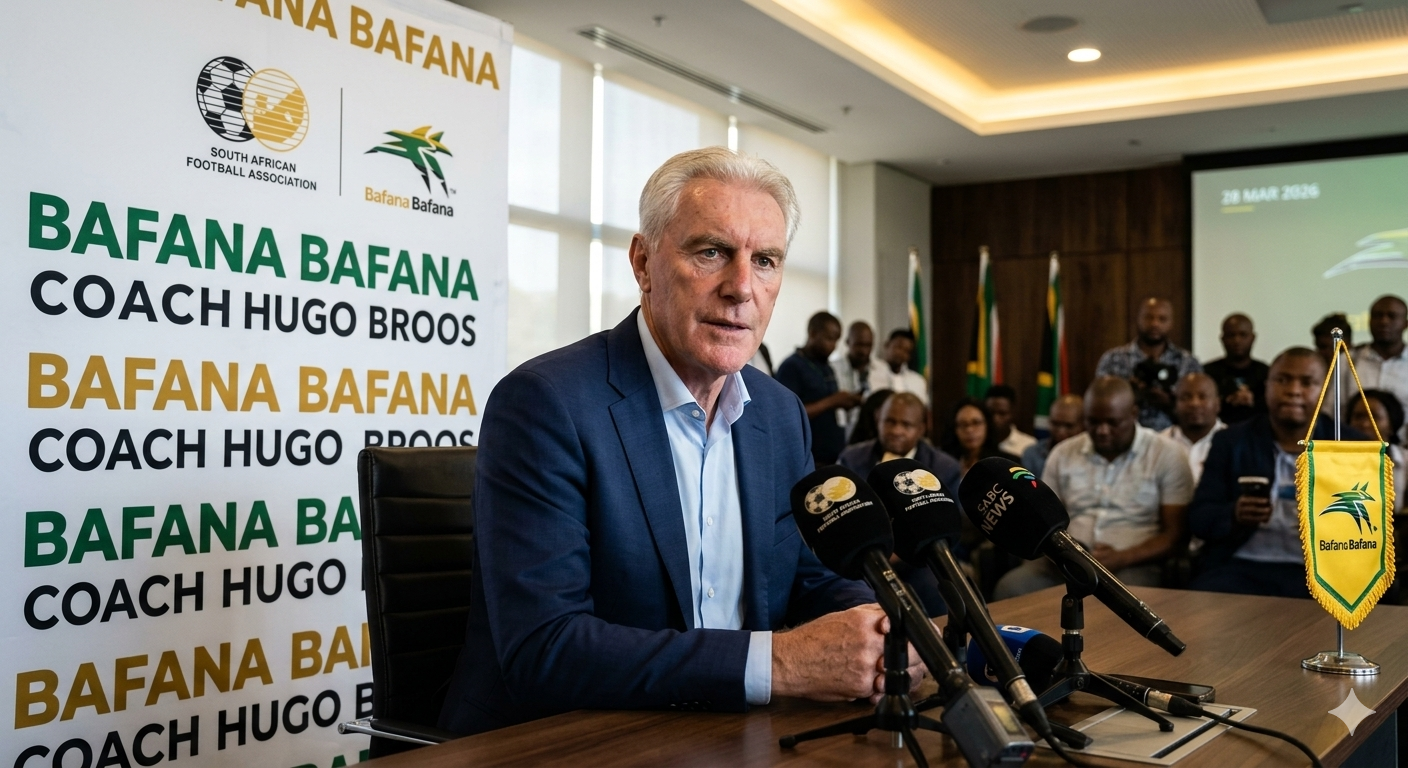
The landscape of South African football is often a place of intense pressure, where memory is short, and patience is a rare commodity. For Hugo Broos, the Belgian tactician who assumed the role of Bafana Bafana head coach five years ago, this journey has been a test of resolve, tactical discipline, and, perhaps most importantly, a masterclass in modernizing a national structure. As his tenure reaches a significant milestone, Broos’ recent statements carry a weight that demands attention: a call for “respect” not just for the results, but for the architectural rebuild of an entire football identity.
When Hugo Broos arrived on the shores of South Africa, Bafana Bafana was a team that had lost its way. The legacy of the 1996 African Cup of Nations glory had become a fading memory, more of a psychological burden than an inspiration. The team was inconsistent, the squad was aging, and there was a palpable disconnect between the immense natural talent in the country and the national team’s performance on the continental and global stage. Broos did not promise instant success; he promised a process. Today, he asks that the journey itself be recognized.
This article provides an in-depth analysis of the Broos era, the fundamental changes he implemented, the specific challenges he overcame, and why his call for recognition is more than just personal vanity—it is a critical reflection point for South African football.
The State of the Nation: A Contextual Blueprint of the Past
To appreciate where Bafana Bafana is today, one must acknowledge the starting point. The 10 years preceding Broos’ appointment were characterized by a merry-go-round of coaches, inconsistent selection policies, and a perceived reliance on star power rather than cohesive system play. South Africa had become a team capable of upsetting global giants but equally capable of failing against lower-ranked continental opponents.
The tactical identity was nebulous. There was a debate between prioritizing the flair and dribbling skills (often associated with South African ‘showboating’ culture) versus the modern European demands of physical dominance, tactical discipline, and high-intensity transition. Broos, a man who had won the AFCON title with Cameroon—a squad that also required a massive overhaul—recognized that a superficial fix would not suffice. He sought to marry the natural technical brilliance of the South African player with a structured, disciplined framework. This approach required a radical shift in philosophy.
Phase 1: The Youth Revolution and the Brutal Pruning
Broos’ first decisive action was controversial and, at the time, deeply unpopular with certain segments of the media and the public. He ruthlessly pruned the squad. High-profile veterans, some of whom had dominated squad lists for years but were failing to produce consistent results, were sidelined. In their place, Broos brought in youth.
He scoured the Premier Soccer League (PSL) not just for names, but for characteristics: speed, adaptability, tactical intelligence, and hunger. The introduction of players like Evidence Makgopa, Teboho Mokoena, and later, the integrating of key Mamelodi Sundowns players, was not accidental. Broos understood that to build a lasting foundation, he needed players who were adaptable, coachable, and capable of playing within a high-tempo system.
This pruning was an act of bravery. It risked immediate backlash if results did not follow, but it was essential to remove the existing hierarchical inertia within the locker room and to cultivate a collective ethos where the team’s system was the star, not the individual. The initial results were rocky, but they showed glimpses of a defined structure that had been missing for years.
Tactical Modernization: The Shift to Systemic Footbal
Broos’ tactical footprint is perhaps his most lasting contribution, regardless of any single result. He transitioned Bafana Bafana from a team reliant on individual brilliance and reactive tactics to one focused on pro-activity and collective spatial management.
1. High-Intensity Transition
Modern football is defined by the moments immediately following a turnover of possession. Broos emphasized an aggressive counter-press the moment his team lost the ball. This required a level of physical fitness and tactical awareness that South African teams had historically struggled with. This approach was particularly evident during South Africa’s strong performances in continental qualifiers and the AFCON tournaments, where they began to suffocate teams that had previously enjoyed comfortable possession.
2. Disciplined Shape
Broos installed a rigid defensive structure. It wasn’t “parking the bus,” but rather a compact mid-block. Every player, including the forwards, had distinct defensive responsibilities. This collective defensive ethos reduced the space between the lines, forcing opponents into difficult passing lanes and making Bafana Bafana significantly harder to beat. The improvement in defensive statistics under Broos is a testament to this structural shift.
3. Utilizing Wide Areas
Recognizing the speed and dribbling ability of South African wingers, Broos’ system often focused on stretching the opponent’s defense. He maximized the use of full-backs as attacking threats (the integration of a modernized ‘inverted’ style, where full-backs sometimes occupy central areas, became noticeable), allowing the true wingers to isolate and challenge opponents one-on-one near the penalty box.
The AFCON Breakthrough: Proof of Concept
The recent AFCON performance stands as the primary tangible piece of evidence for the success of Broos’ system. While South Africa did not win the tournament, their third-place finish (bronze medal) was the country’s best result in 24 years. It was not the result, however, but the manner of the performance that validated the five-year journey.
Bafana Bafana played with a level of tactical sophistication that disarmed many. They went toe-to-toe with powerhouse nations like Morocco (the World Cup semi-finalists) and showed resilience in knockout scenarios. The penalty shootout heroics of goalkeeper Ronwen Williams were the headline, but Williams himself was supported by a defensive structure that limited opponents’ clear-cut chances. The tournament showcased a unified, drilled, and belief-driven Bafana Bafana—a team that finally looked comfortable in its identity on the biggest continental stage.
Beyond the Pitch: Professionalizing the Environment
Broos’ contribution has not been limited to the tactical board. Part of his journey has been a relentless lobby for professionalizing the support structures around the national team. Coming from a sophisticated European football infrastructure, he was often critical of the administrative challenges faced in South African football.
He emphasized the need for better integration with the PSL, improved medical support, enhanced video analysis capabilities, and, most critically, a dedicated and synchronized calendar to ensure maximum preparation time for qualifiers. His public demands—often perceived as prickly by the local football federation—were fundamentally driven by a desire to provide his players with the best possible platform for success. By forcing a discussion on these structural weaknesses, Broos has helped modernize the national team’s entire operation, a contribution that will benefit South Africa long after he has departed.
Analyzing the Call for ‘Respect’
When Hugo Broos speaks of “respecting the journey,” he is not simply seeking plaudits. He is addressing a systemic issue in how South African football success is often viewed. The culture is often binary: you win or you are a failure. Broos is arguing for a more nuanced appreciation of progression.
His frustration likely stems from the fact that despite the historical achievement at the recent AFCON, the conversation often reverts to past failures or demands for the next trophy immediately. The call for respect is an acknowledgment of:
1. The Immense Starting Difficulty
The depth of the slump Broos inherited cannot be overstated. He had to reverse decades of structural stagnation. To achieve continental respectability within five years is a testament to the effectiveness of his methods and the players’ commitment to them.
2. The Cultural Resistance to Change
Changing the profile of the national team required displacing established figures and ingrained tactical habits. Every major change Broos made was met with significant resistance and intense scrutiny, yet he remained steadfast, demonstrating remarkable resilience and conviction.
3. The Creation of a Sustainable Model
Broos has not just bought short-term success by relying on aging stars; he has built a youthful, modern team with a defined identity that can serve South Africa for the next five to seven years. This long-term value is often overlooked in the heat of discussion about immediate results.
The Paradox of Success: Elevated Expectations
Ironically, Broos’ own success has become his greatest challenge. By taking the team to a bronze medal at AFCON, he has elevated the nation’s expectations. The conversations have shifted from “How can we avoid defeat?” to “We must win this tournament.”
This is a dangerous trap. While ambition is necessary, the reality is that South African football infrastructure is still a work in progress. Broos’ call for respect is also a plea for realism. He knows that Bafana Bafana is on a good trajectory, but that progress is not linear. There will be setbacks. Respecting the journey means recognizing that a setback does not nullify the structural gains made over the last five years.
The Role of Domestic League Synergies
A key element often under-appreciated in Broos’ journey is the synergy he developed with South African domestic club coaches, particularly at Mamelodi Sundowns. Sundowns’ dominance in the PSL and their successful deep runs in the CAF Champions League provided Broos with a core of players who were already accustomed to high-stakes continental football and, crucially, a highly tactical and disciplined system under coach Rhulani Mokwena (and previously Pitso Mosimane).
Broos was smart enough not to work against this successful existing structure but to build upon it. He incorporated the core defensive and midfield spine of Sundowns, allowing him to accelerate the national team’s cohesive play. This strategic selection policy, while sometimes criticized for favoring one club, was a pragmatic decision that prioritized collective performance over the appearance of equality among clubs.
A Legacy in Transition: The Future Road
Hugo Broos has provided a clear roadmap. The team has a tactical system, a strong collective spirit, and has proven it can compete at the highest continental level. As he looks to the future, the immediate challenges are clear: qualifying for the 2026 FIFA World Cup and continuing to build depth within the squad.
His call for respect is a challenge to all stakeholders—media, fans, and the federation—to view the national team’s progress through the lens of a long-term project. The foundation has been laid. It is a modern, strong, and sustainable foundation. Broos’ tenure will be remembered not just for any single victory, but as the period when South African football finally embraced a coherent, disciplined, and forward-thinking football ideology.
Conclusion
Hugo Broos’ five-year rebuild of Bafana Bafana stands as one of the most significant architectural overhauls in modern South African sporting history. He arrived in a time of doubt, implemented a revolution based on youth and systematic tactical discipline, and delivered a result that restored the nation’s continental pride.
His call for “respecting the journey” should be heard not as a moment of ego, but as a crucial moment of reflection for a country that often forgets its past in its desperate demand for the future. The real achievement is that Hugo Broos has given Bafana Bafana an identity again. He has provided a roadmap for sustainable competitiveness. Whether Bafana Bafana continues on this road or diverges is a question for the future, but the roadmap created over the last five years is Broos’ legacy—and it is a legacy that deserves profound respect. The transformation of South African football is not complete, but under Hugo Broos, the journey back to relevance has undoubtedly begun.
Deixe um comentário